
Past Events
GrundrechteClinic Summer Party – in cooperation with the Refugee Law Clinic Berlin
What a wonderful summer party!
On July 1, 2026, we had the pleasure of celebrating this year’s summer party at the School of Law together with the Refugee Law Clinic Berlin.
A special highlight was the screening of the short film “The Delivery Guy” by Debarun Dutta. The film and the discussions that followed provided important insights into the realities of life for migrant workers in the delivery industry and sparked many fascinating conversations.
Equally enriching were the presentations and projects from the current cycle, which once again demonstrated just how dedicated and diverse the work at the Fundamental and Human Rights Clinic is.
A heartfelt thank you to everyone who made this evening possible: the Refugee Law Clinic Berlin, the team at the GrundrechteClinic, and the HLCMR Support Association, as well as all participants, guests, and volunteers.
We’re already looking forward to another inspiring cycle of the GrundrechteClinic and the evenings we’ll spend together!




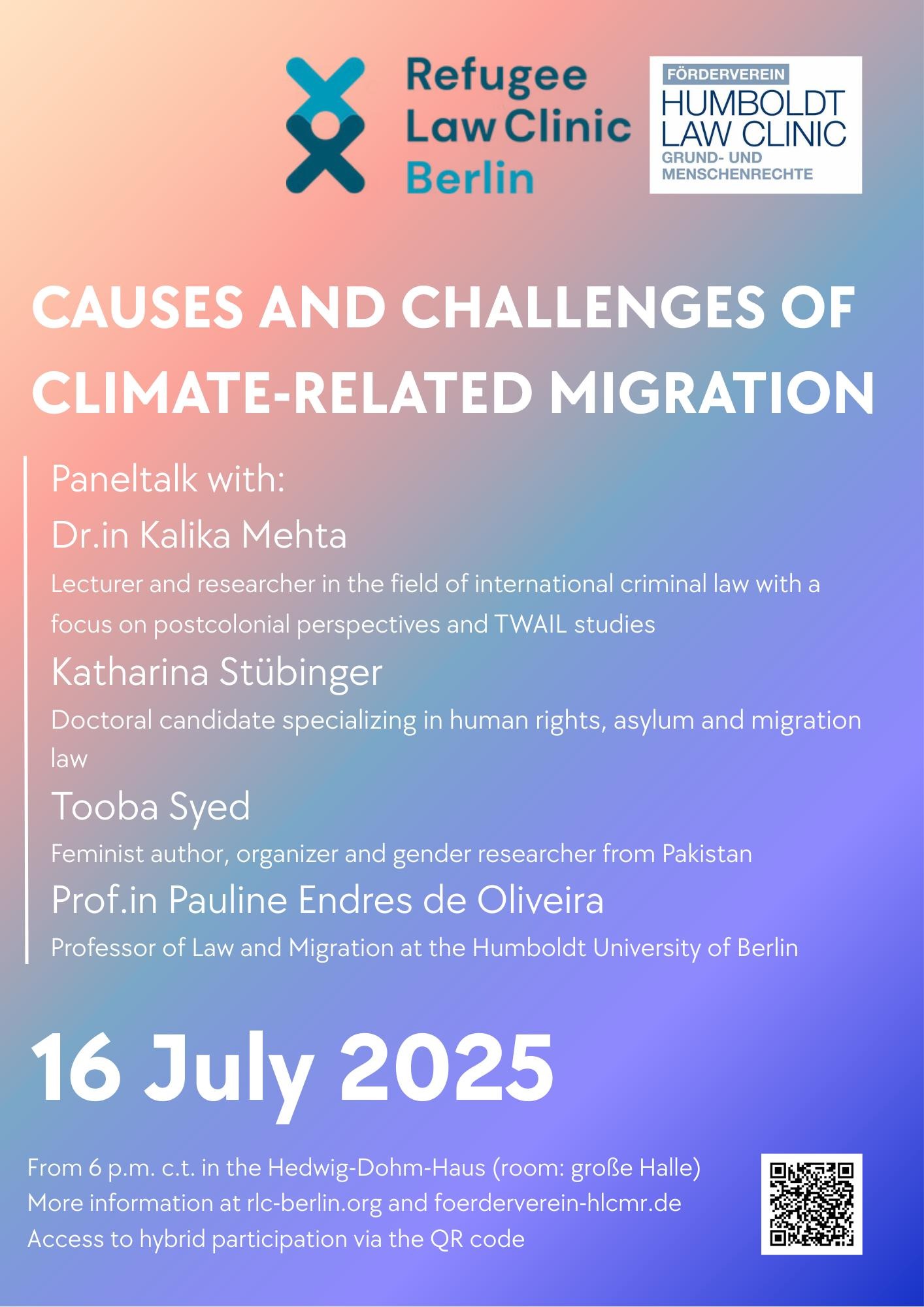
The Refugee Law Clinic Berlin and the Humboldt Law Clinic for Fundamental and Human Rights co-hosted a semester event featuring a panel discussion on the causes, challenges, and consequences of climate-induced migration.
Together with Dr. Kalika Mehta, Katharina Stübinger, Tooba Syed, and Prof. Dr. Pauline Endres de Oliveira, legal, political, and social issues surrounding climate-induced displacement and migration were discussed. The focus was particularly on gaps in protection within existing migration and refugee law, the impacts of the climate crisis on particularly affected regions, and possible legal and political responses.
The event took place at the Hedwig-Dohm-Haus in Berlin and was also available via Zoom livestream. It offered students, practitioners, and interested members of the public the opportunity to learn about and discuss various perspectives on a highly topical human rights issue.

The information session offers anyone interested the opportunity to learn more about the program’s structure and curriculum and to ask questions. The event is open to all law students at HU and FU, as well as master’s students in Gender Studies at HU.
The summer party is a great opportunity to meet current and former participants, partner institutions, and supporters over snacks and drinks. Interested students can also get information directly about the next cycle.
Since the global spread of COVID-19, social distancing as well as infection control and quarantine measures has a significant impact on everyday life. However, these existential protection measures are often not feasible for refugees in refugee shelters.
For years, refugees have been complaining about disastrous hygienic conditions and lack of privacy in refugee shelters. Under such circumstances it is nearly impossible to comply with the additional hygiene measures required in the fully occupied accommodations with shared rooms, communal sanitary facilities and kitchens. There is also a lack of information about the disease, legal regulations and necessary protective measures.
The lack of medical, psychosocial and legal advice aggravates the situation, especially for fundamentally vulnerable groups such as women, children and LGBTIQ persons and for COVID-19 risk groups. This is compounded by inadequate and disproportionate crisis management. Entire shelters are being quarantined. Infected persons are transferred at short notice. Fear and panic are spreading. Instead of receiving information, refugees face massive police operations in response.
Even beyond their accommodation, the pandemic poses problems for refugees and their lawyers when it comes to enforcing their rights.
We would like to discuss all this from the perspective of the people affected, from the perspective of lawyers, and from the perspective of basic and human rights:
Jennifer Kamau, International Women’s Space Berlin
Barbara Wessel, Attorney at Law in Berlin
Sarah Lincoln, Gesellschaft für Freiheitsrechte (GFF)
Am 22. Oktober 2019 fand eine Podiumsdiskussion zum Thema “Institutionelle Rassismus jenseits des Nsu-Komplet als rechtliche Herausforderung” statt.
Hintergrund und Ziel der Veranstaltung
Seit 1966 ist die Bundesrepublik Deutschland durch die Ratifizierung der Anti-Rassismus-Konvention (ICERD) verpflichtet, alle Menschen in ihrem Hoheitsgebiet vor allen Formen der rassistischen Diskriminierung zu schützen. Doch die Ermittlungen und die Aufarbeitung des NSU-Komplexes haben besonders deutlich gezeigt, wie groß das Problem mit institutionellem Rassismus in Deutschland ist. Dieser strukturell verankerte Rassismus in Deutschland ist auch einer der zentralen Kritikpunkt in allen Parallelberichten an den UN-Antirassismus-Ausschuss im Jahr 2015.
Bei der Beseitigung von rassistischer Diskriminierung stellt die Bekämpfung von institutionellem Rassismus einen wichtigen Bestandteil dar. Die Bekämpfung institutionellen Rassismus ist ein komplexes Thema, das bis jetzt nicht ausreichend wissenschaftlich behandelt wurde. Vielmehr bedarf es in diesem Bereich weiterer praxisbezogener Forschung.
Im Bildungsbereich liegen im Gegensatz zu den juristischen Einrichtungen und der Rechtswissenschaft bereits erste empirische Forschungsergebnisse zu dem Thema vor. Das Hauptanliegen der Veranstaltung war es, von diesen Erfahrungen zu lernen. Um weitere Forschung zu erleichtern, ist es vor allem interessant, sich anzuschauen, wie die Forscher*innen den Begriff des institutionellen Rassismus definieren und welche Forschungsmethoden sie dabei anwenden.